






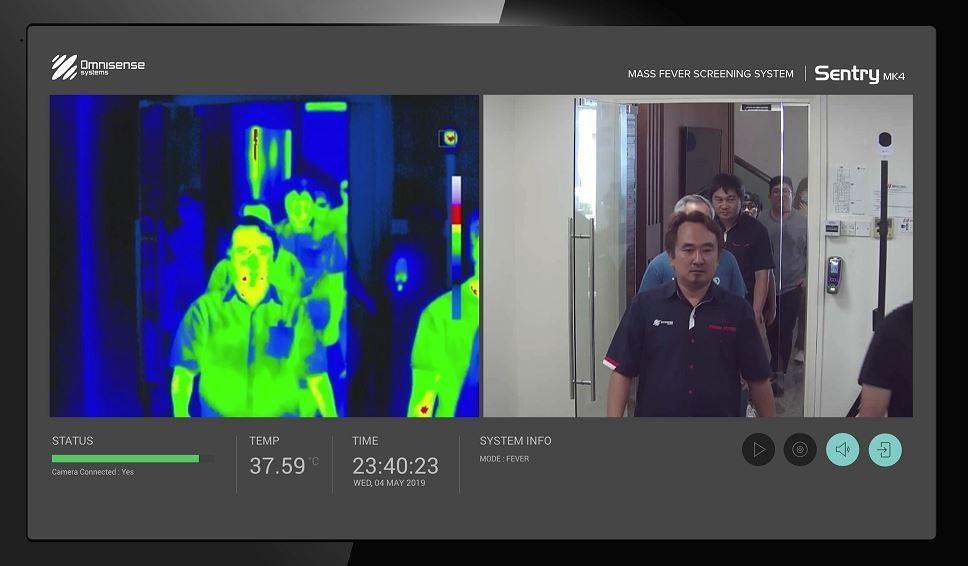
PHILADELPHIA, Pa. (WLVT) - Heat-reading tools have been used since the beginning of the pandemic to screen people for fever.
Many U.S. households are now more accustomed to the tech, and use handheld infrared thermometers in place of glass thermometers to check temperatures at home.
As businesses across the country reopen, Andrew Southern, founder of Invisible Health Technologies, says widespread temperature scans in public places are likely to become a new norm.
''Let’s say, an office building or an aquarium is ready to reopen. They want to create safeguards for their employees and guests. We can come in with thermal scanners, UV light systems to clean and air filtration systems -- all technologies which help in managing our current situation,'' Southern told PBS39.
CHECKING CROWDS FOR FEVER
Southern formed his company in April in response to the coronavirus pandemic. The New York-based group creates strategies for reopening large spaces like malls and amusement parks by using tech, like thermal scanners, to detect fevers.
''Basically, the scanners are like surveillance cameras, but they sense heat. So, from the wavelengths from our skin, they can sense our temperature. An alert is created if someone is over core body temperature,'' explained Southern. ''There’s a couple of different set ups. One is a meter that you have to look into for three to five seconds to get a reading. There’s other ones that allow you to walk right through without stopping. That’s how we handle large groups of people at an airport, stadium or shopping mall.''
If your temperature is above 100-degrees, you could be denied entry.
PRIVACY CONCERNS
Some say the scanners are a gateway to surveillance culture.
''In the name of public health interest, especially during a pandemic, it’s easy to make the argument that whatever we’re doing is what we should be doing, because it’s for the greater good,'' Scott Gingold, president of Lehigh Valley Technology Company, told PBS39. ''Still, we have to walk gingerly here, because we’re not sure if there’s a big benefit to this. When you’re using a handheld thermometer, it’s likely not connected to a server or database that will transmit that data. In theory, it’s between the person taking the temperature and the person who is getting their temperature taken.''
Southern says the scanners that he recommends operate in real-time and don't store recordings for long periods of time.
TESTING: 1, 2, 3
Temperature checks at building entrances will likely stick around for awhile. Since March, ’'temperature checker’’ positions have opened at health networks and other companies around the Philadelphia and Lehigh Valley region.
Southern says he believes large scale thermal scanners will play a critical role in reopening the economy.
''We all understand now, more than ever, that our health can affect other people’s health in public spaces,'' he said. ''We should not be going out if we have a fever, an elevated temperature, because it may mean that we’re ill. It’s not the only thing to manage this pandemic or future pandemics, but it is a tool that we have at our disposal.''
WATCH THE REPORT: View the full Tech Takeover report on thermal scanners in the video player below