






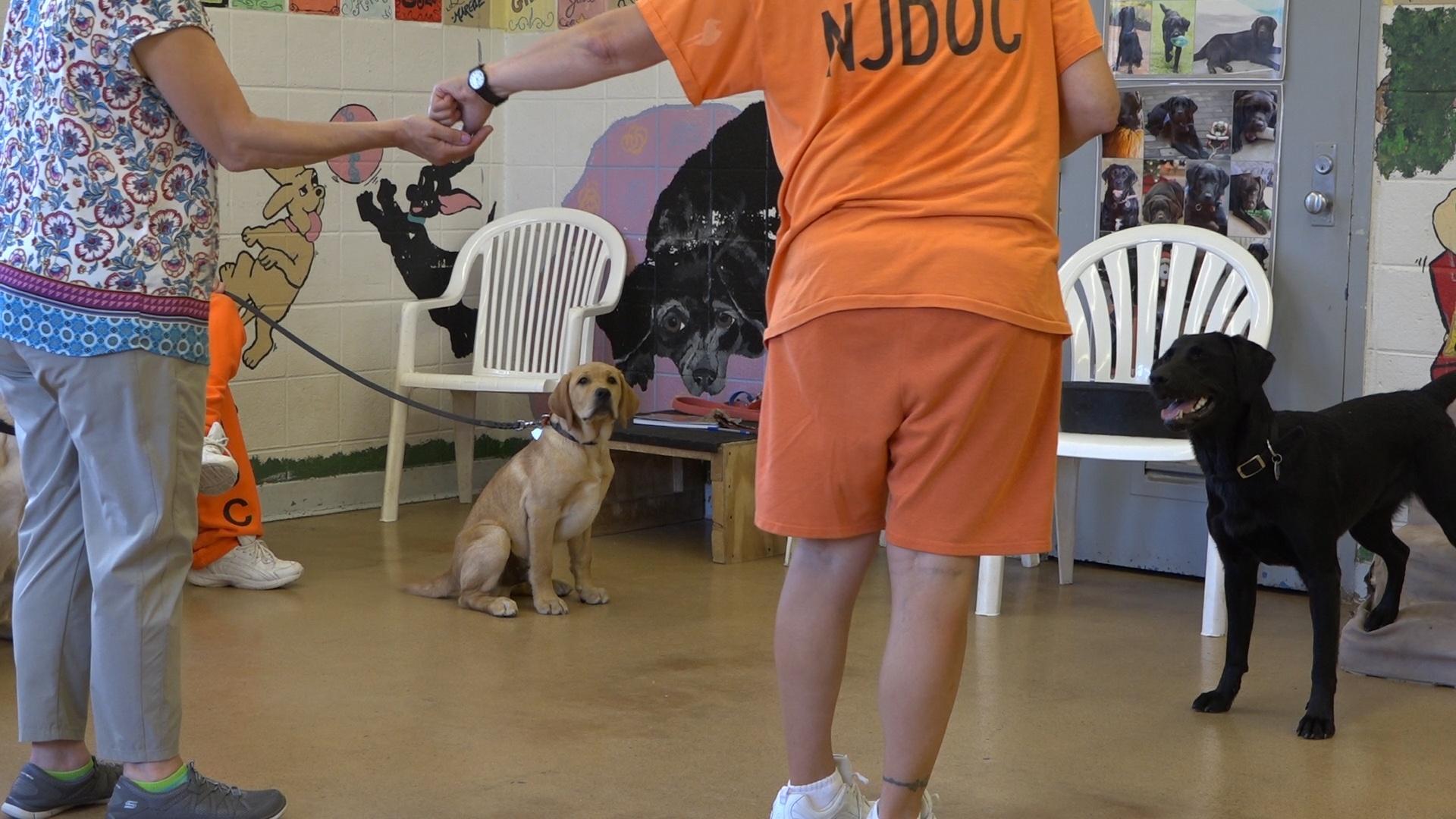
CLINTON, NJ - Four legged pups are training inside the four walls of a prison cell here in Hunterdon County. But for female inmates serving time inside, it’s much more than prepping pups for service. “Even though it’s a negative situation and we put ourselves in a negative predicament, we’re doing something for the better and we’re doing something beyond us and it’s really fulfilling.”
The Puppies Behind Bars program pairs inmate puppy raisers with working dogs; the pairs spend 24 hours a day together, from the time they’re just 8 weeks old until the canines graduate between the ages of 12 and 24 months, when they’ll go on to work for the Bureau of Alcohol, Tobacco, Firearms and Explosives, the NYPD, CIA or become therapy dogs for service veterans.
“We have to teach the dogs obedience,” explains Jan Brady of Puppies Behind Bars, “We have to get the dogs lots of exercise and help them become very confident on under footings, confident in different situations, and have focus also for their work.”
The animals are being groomed to become service dogs for wounded war veterans and first responders. But with many prepping for their next task; working as explosive detection canines for law enforcement, and a job on the line, keeping canine companionship at a leash’s length can be tough. After spending up to two years together, these dogs become like family for inmates.
“I’m still grieving over my first pup that I raised from a pup, his name was Zeus, and he went off to the ATF, graduated and went off the US Marshals,” explains inmate Nicole Guyette, “It’s still been really hard for me even though I know he’s doing so many good things and he’s traveling and he’s saving lives and going to save so many lives. It’s such a great thing but it hurts in the sense that you fall in love with them, you can’t help but fall in love with them--being with them 24/7 and having them to weather those storms and stressors that come along in life. You grow a really special bond with them and it’s hard to see them go.”
Toni is another one of the 15 women who currently participate in Puppies Behind Bars here at Edna Mahan Correctional Facility. Sentenced to 7 years for her involvement in a hit and run that left a 15-year-old girl dead back in 2015, Toni understands the extent of her crime, but feels her new purpose here behind bars is to give back to law enforcement, training an animal who could one day save lives.
“I wasn’t under the influence or anything but I left the girl there,” says Toni Marletta, “So, that’s why in a way, it’s very for me being here, I’m okay with it because that mom lost her daughter. Me, I can do the 4 years that I have to do here and I’m okay. And that’s why I’m doing this too. It just makes me feel good about, not about the situation, but I’m giving something back to society.It means everything to me. That’s why these dogs are so special because whether they are going into fires, explosives, they’re still saving lives, they’re looking for lives, helping us protect this country and that’s a big honor.”
For inmates like Pamela who been training with her first puppy pal since she was two months old and will be leaving soon to work as an Explosives Detection Canine, this dog has taught her more than she could imagine.
“The hardest experience would be when she goes to leave to be with either the ATF, CIA or NYPD, wherever she is to go. I think that’s going to be hard,” explains inmate Pamela Zahn, “They say try not to get attached etcetera...but how can you not? You’d be a heartless person not to get attached to this cute little face you know?I never thought I could do something like this, you know? I never thought I could train dogs or I would be good at doing it. But now that I see how good I am doing it and how much I like it, I think I might have a new career on the outside. So, I’ve learned something about me while doing this and you know, luckily from what I understand, they accept felons. So, you know, it’s a good thing and i have all my training while I’m in here. So, I can go out on the outside and do something positive with my life.”
And while similar dog training programs exist at men’s prisons, Jan Brady, of Puppies Behind Bars says, female inmates make perfect handlers for some of the same reasons it makes it difficult for them to say goodbye when their pups graduate the program.
“Many of our women have children, you know, they may have young children and they have older children, so they have an awareness already of taking care of something. I think that gives them an attentiveness; particularly when it comes to watching to dog’s body language, is he limping, is he walking funny, oh my gosh I didn’t see that tiny little scratch there before. And I think that’s something particularly mothers, are good at.”
Since its invention in 1997, Puppies Behind Bars has helped inmates raise more than 1200 puppies, giving pups and prisoners a new leash on life.
The Puppies Behind Bars program pairs inmate puppy raisers with working dogs; the pairs spend 24 hours a day together, from the time they’re just 8 weeks old until the canines graduate between the ages of 12 and 24 months, when they’ll go on to work for the Bureau of Alcohol, Tobacco, Firearms and Explosives, the NYPD, CIA or become therapy dogs for service veterans.
“We have to teach the dogs obedience,” explains Jan Brady of Puppies Behind Bars, “We have to get the dogs lots of exercise and help them become very confident on under footings, confident in different situations, and have focus also for their work.”
The animals are being groomed to become service dogs for wounded war veterans and first responders. But with many prepping for their next task; working as explosive detection canines for law enforcement, and a job on the line, keeping canine companionship at a leash’s length can be tough. After spending up to two years together, these dogs become like family for inmates.
“I’m still grieving over my first pup that I raised from a pup, his name was Zeus, and he went off to the ATF, graduated and went off the US Marshals,” explains inmate Nicole Guyette, “It’s still been really hard for me even though I know he’s doing so many good things and he’s traveling and he’s saving lives and going to save so many lives. It’s such a great thing but it hurts in the sense that you fall in love with them, you can’t help but fall in love with them--being with them 24/7 and having them to weather those storms and stressors that come along in life. You grow a really special bond with them and it’s hard to see them go.”
Toni is another one of the 15 women who currently participate in Puppies Behind Bars here at Edna Mahan Correctional Facility. Sentenced to 7 years for her involvement in a hit and run that left a 15-year-old girl dead back in 2015, Toni understands the extent of her crime, but feels her new purpose here behind bars is to give back to law enforcement, training an animal who could one day save lives.
“I wasn’t under the influence or anything but I left the girl there,” says Toni Marletta, “So, that’s why in a way, it’s very for me being here, I’m okay with it because that mom lost her daughter. Me, I can do the 4 years that I have to do here and I’m okay. And that’s why I’m doing this too. It just makes me feel good about, not about the situation, but I’m giving something back to society.It means everything to me. That’s why these dogs are so special because whether they are going into fires, explosives, they’re still saving lives, they’re looking for lives, helping us protect this country and that’s a big honor.”
For inmates like Pamela who been training with her first puppy pal since she was two months old and will be leaving soon to work as an Explosives Detection Canine, this dog has taught her more than she could imagine.
“The hardest experience would be when she goes to leave to be with either the ATF, CIA or NYPD, wherever she is to go. I think that’s going to be hard,” explains inmate Pamela Zahn, “They say try not to get attached etcetera...but how can you not? You’d be a heartless person not to get attached to this cute little face you know?I never thought I could do something like this, you know? I never thought I could train dogs or I would be good at doing it. But now that I see how good I am doing it and how much I like it, I think I might have a new career on the outside. So, I’ve learned something about me while doing this and you know, luckily from what I understand, they accept felons. So, you know, it’s a good thing and i have all my training while I’m in here. So, I can go out on the outside and do something positive with my life.”
And while similar dog training programs exist at men’s prisons, Jan Brady, of Puppies Behind Bars says, female inmates make perfect handlers for some of the same reasons it makes it difficult for them to say goodbye when their pups graduate the program.
“Many of our women have children, you know, they may have young children and they have older children, so they have an awareness already of taking care of something. I think that gives them an attentiveness; particularly when it comes to watching to dog’s body language, is he limping, is he walking funny, oh my gosh I didn’t see that tiny little scratch there before. And I think that’s something particularly mothers, are good at.”
Since its invention in 1997, Puppies Behind Bars has helped inmates raise more than 1200 puppies, giving pups and prisoners a new leash on life.